
Automatic Negative Thoughts and The Beginning of Processing Them:
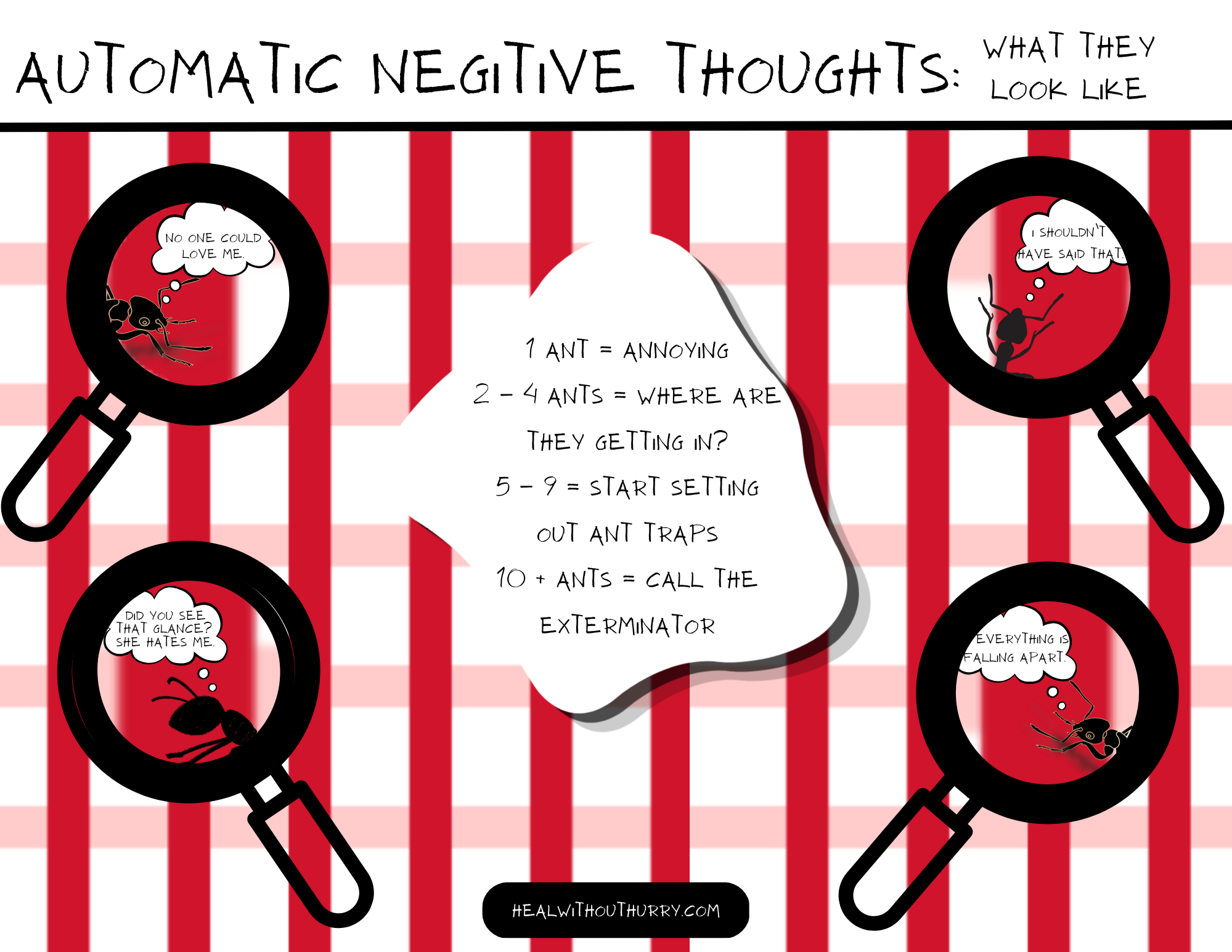
Automatic Negitive Thoughts – aka. ANTs

Disclaimer: I am not a doctor or therapist. The concept of ANTs is a common mental health acronym. The following is my interpretation of the concept of ANTs.
Ants are basically the intrusive thoughts you have on repeat in your head. I imagine it like somehow there is a big crumb left in your brain and the ant is traveling back and forth over the same neuron from its home to the crumb and back again. And, of course, the more it travels on this path and realizes there is plenty of food, it will continue to travel and run the same neuron response over and over. And, this sucks because we really want our brain to be more quiet and stop thinking such negative things. The more the ants get the food, the more I buy into the thought and think it is mine.
In therapy they teach challenging those thoughts with questions like: Who taught you that? Or Who told you that? Then they might have you think on: Do you want to subscribe to that thought?
Let’s say you are subscribed. What then does that mean? Like any good subscription, you are paying a monthly fee [probably feels more like weekly, daily, or hourly]. It might be costing you money, but it is also most definitely costing you mental energy, emotional bandwidth, mental capacity, relationships, and opportunities. Add that all together, and I think that is more of a rip off than the current prices of a Netflix subscription [like even the one with ads, which is still a rip off]. Well, we definitely do not want to be subscribed to that.
Oh but it goes deeper than that. You might find you are on auto-pay and auto-renewal. You have been renewing this crap without even knowing you still had the subscription. But, see, auto-pay and auto-renewal have some comfort to them. If it is on “auto-anything”, you don’t have to think about remembering it. Your brain is like, “Don’t worry. I got this. This worked for us in the past. [or ‘Someone told us this’] I will play it for you whenever you need it [with a smile and a wink].”
We get to the point where we are thinking this automatic negative thought, and we either don’t know why we are having it anymore or we haven’t processed where we got it from. That is where we get the question: Does this thought fit you, how you are now, or how you want to be? Well, if the thought doesn’t fit, let’s change it. Not saying it will be easy. It would be like throwing out a pair of worn in gym shoes that stink up your coat closet, but thinking, at least they are worn in.
On the other hand, when we ask the question: Who taught you that? Or, Who told you this? You might realize someone else signed you up for a subscription. It might have been someone we love, loved, trust, or used to trust. It might have been someone who by their position in our life was expected to put our best interest first, like a parent, grandparent, teacher, or coach. Unfortunately, not everyone who was supposed to be good for us was good to us.
It would be like finding out your mom signed you up for a Planet Fitness subscription and thinking to yourself, well, I’ll pay it because mom wants what is best for me [or moms are expected to want the best for their child]. Frankly, it does not matter what: “who” or “why” led to that Planet Fitness subscription. Whenever you decide the subscription doesn’t fit you anymore, it is going to be a massive pain in your behind to cancel it.
The realization that someone who seemed trustworthy wasn’t worthy of your trust, hits deep in your chest and stings a little, or at least it did for me. It reminds me of how Amazon was tricking people into subscriptions for Prime. On top of that, it was also intentionally made complicated to cancel the subscription. Of course, when people noticed, they got angry and filed a lawsuit. So, ideally, you have identified a thought, realized the reality of what is going on [you are being tricked], decided you don’t want to be subscribed, and now you’ve got to get angry.
I have heard a few times that healing involves anger. I want you to know that this thought is not you, and you’ve got to get angry about it being there. Not mean angry, but an I am done with this crap, angry. If we just smush the ant, it might not kill it. We have got to stomp on that little sucker. Not only do we need to stomp on that ant, but we need to figure out how and where it got in because we are getting angry enough that we don’t want to see another one ever again.
Of course, as any home owner or apartment dweller would know, no matter how well you seal up a house, the ants continue to find their way in every once in a while. But, we are aiming to give your mind a little reprieve and a chance to rest. It has surely raced enough to have won a wall of gold metals in mind racing. We have got to retire that darn horse.
All of this to say or admit that I don’t really have an answer. I am not a physician or therapist by any means. The only grounds I stand on is a personal Major Depressive Disorder diagnosis [in my case, recurrent]. I am struggling with this myself.
I do have some suggestions though. When we get angry, anger often is signaling a boundary that was crossed, so I would suggest investigating your boundaries. If you identified someone who signed you up for a subscription, I would investigate how any of their current involvement in your life is impacting you. My best suggestion is to not fight the ants alone. It can be a lot to deal with ants on your own, especially an ant infestation. And, we are not talking about the little tiny ants. We are talking about the huge black ants that don’t die after the first smush. Don’t be afraid to call an exterminator [therapist]. With love.
Time for some Psychoeducation. Yay! [No, seriously, this is some of my favorite stuff to think about.] Below, I have attached the following images as downloadable PNGs. Please feel free to use these pages for personal or group therapy use. [Please, do not use them for any selling purposes.] Again, I am not a doctor or a therapist. The psychoeducation below is my take on the existing mental health concept.


Leave a Reply